
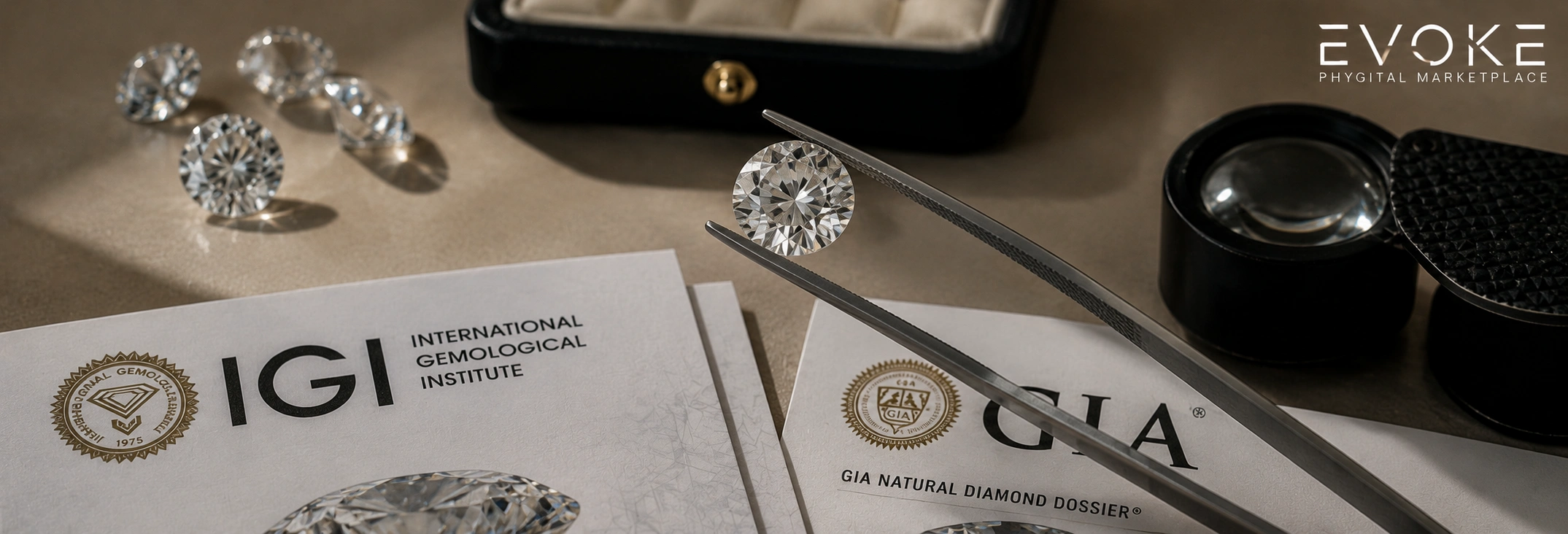
Ask five jewelers which diamond certification matters most, and you'll likely get five different answers. The IGI vs GIA certification debate comes up constantly, yet most buyers still don't understand what these labs actually do differently, or why it matters for the price they pay.
As more diamond purchases move online, buyers increasingly expect a certificate before they'll trust a listing. But not all certificates carry the same weight, and understanding IGI vs GIA certification before you buy can be the difference between a fair price and an overpaid one.
What Is Diamond Certification, and Why Does It Exist?
Diamond certification is an independent lab's assessment of a stone's cut, color, clarity, and carat weight, the 4Cs. Certification exists so buyers don't have to rely solely on a seller's word; a third-party report provides an objective, documented grade.
Without this, two visually similar diamonds could be priced wildly differently with no way for a buyer to verify why.
GIA Certification: The Long-Standing Grading Standard
GIA certification comes from the Gemological Institute of America, widely regarded as the strictest and most conservative grading lab in the industry. GIA created much of the grading language the diamond trade still uses today, and its reports are considered the benchmark for natural diamond certification.
Because GIA's grading tends to be more conservative, a GIA-graded stone often carries slightly more buyer confidence, and sometimes a higher resale value, than an identically graded stone from another lab.
IGI Certification: The Standard for Lab-Grown Diamonds
IGI certification has grown rapidly alongside the lab-grown diamond certification market. The International Gemological Institute (IGI) grades both natural and lab-grown stones, but it has become the dominant lab specifically for lab-grown diamonds, where GIA involvement has historically been more limited.
IGI's grading is generally considered slightly more generous than GIA's, which is one reason IGI vs GIA certification comparisons often show a perceived one-grade difference between the two labs for a similar stone.
This distinction matters even more when comparing stone types altogether, something we cover in detail in lab grown diamonds vs natural diamonds, including how certification choice interacts with price and long-term value.
How Evoke Marketplace Supports Certified Diamond Buying
Every certified diamond listed on Evoke Marketplace includes the issuing lab and a full grading report, so buyers can transparently compare IGI vs. GIA certifications before purchasing, rather than discovering the difference after the fact.
IGI vs GIA Certification: Key Differences at a Glance
Factor | GIA | IGI |
Grading strictness | More conservative | Generally more generous |
Primary specialty | Natural diamonds | Lab-grown diamonds |
Market recognition | Considered the gold standard | Growing, especially for lab-grown |
Typical turnaround | Slower | Faster |
Resale confidence | Slightly higher | Solid, but lab-grown dependent |
Does Certification Lab Actually Affect Diamond Value?
Yes, but not because one lab is "fake" or unreliable. It comes down to grading consistency. A diamond graded VS1 by GIA and one graded VS1 by IGI may not look identical side by side, because IGI's grading scale tends to run slightly more favorable.
This is why diamond grading consistency matters more to buyers focused on resale or appraisal than to buyers purchasing purely for personal wear.
Buying Considerations: What to Verify on Any Certificate
Before trusting any certified diamond jewelry purchase, verify:
The certificate number matches the lab's online verification database
The grading date is reasonably recent
The report includes a plotted diagram of inclusions, not just a summary grade
The lab is clearly named and traceable; avoid unnamed or generic "certified" claims
Luxury Commerce Implications: Certification and Buyer Trust
In fine jewelry specifically, diamond quality perception is inseparable from trust in the certifying lab. Gift buyers and collectors increasingly research grading standards before purchasing, treating certification the same way they'd treat authentication on any luxury good, as covered in Ethical Gemstones, where sourcing transparency plays a similar trust-building role.
How Evoke Marketplace Embraces Transparent Grading Standards
Rather than listing "certified" without context, Evoke Marketplace clearly labels whether a stone carries GIA, IGI, or another recognized certification, helping buyers make an informed decision aligned with how they plan to use or resell the piece.
IGI vs GIA for Lab-Grown vs Natural Diamonds
Buying natural:
GIA certification is generally preferred for maximum resale confidence
Buying lab-grown:
IGI certification is the market standard and widely accepted
Buying for resale/investment:
GIA's conservative grading tends to hold value more predictably
Buying for personal wear:
Either lab is reliable if the certificate is verifiable
The Future of Diamond Certification
Expect certification to increasingly integrate with digital verification, QR-linked reports and blockchain-backed records that let buyers instantly confirm authenticity, reducing reliance on paper certificates that can be lost or misrepresented.